

I have a deck
See where your investment story loses conviction and what to change first.
Analyze my deck freeAI pitch deck analysis across 10 investor frameworks
Deckmetric scores your deck against the Shepard&Young CVM framework and nine benchmark VC frameworks, shows where investor conviction breaks, then helps you rebuild the story, the round logic, and the outreach that follows.
Not ready to upload yet? Start with a quick valuation.No credit card · Your deck is not used to train models · Delete anytime · Results in under 10 minutes
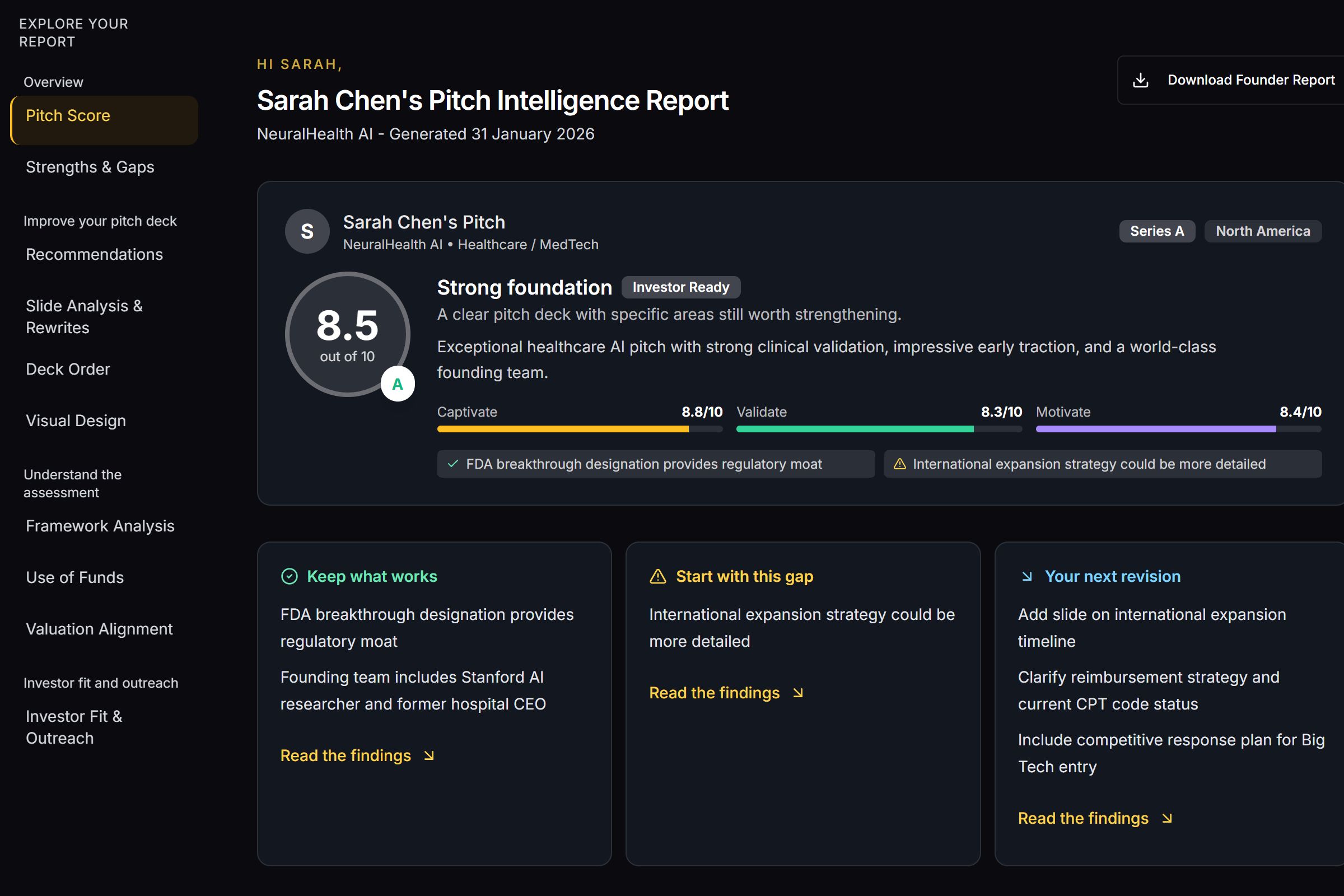
Start free with your CVM score, benchmark scores and first strengths and gaps.
Premium adds slide-level feedback, concrete rewrites, visual review and an ordered revision plan.
Use investor fit and outreach guidance to connect your pitch deck with the audience you want to reach.
Your next step
See where your investment story loses conviction and what to change first.
Analyze my deck freeUse the free CVM Framework Guide before you write or rebuild your slides.
Get the free guideWork through the story with Sebastian, with preparation and a written action memo.
Explore the IntensiveTwo illustrative pitch decks show how clarity, evidence and a credible ask affect the assessment. These are separate sample profiles, not a before-and-after result. They do not promise funding.
Early-stage concept with gaps in market validation and competitive positioning.
Exceptional pitch with strong clinical validation, impressive traction, and world-class team.
Tools to work through it yourself
Choose the kit for the task in front of you. Each is a one-time purchase with practical files you can work through at your own pace.

$19 USD · One-time
Framework, slide template, audit worksheet and a worked example.
Explore the Pitch Deck Audit Kit
$149 USD · One-time
Work through the round, use of funds and the logic behind your numbers.
Explore the Round Logic Kit
$28 USD · One-time
Build a focused outreach process and the messages that support it.
Explore the Investor Outreach KitNeed all three? The Founder Toolkit Bundle includes the Audit, Round Logic and Outreach kits for $179 USD.
See the bundlePDF, PPTX, or DOCX. Up to 25 MB. Your deck stays private and encrypted.
See how investors are likely to read the story, with a CVM score, 9 framework benchmarks, top strengths, and critical gaps, results in under 10 minutes.
Premium pinpoints the slides, story gaps, visual issues, and investor-fit signals to improve, then prioritizes the work.
Apply the recommendations, re-upload the improved deck, and see whether the investment story now lands more clearly.
Lite finds the first gaps. Premium shows exactly what to fix, where to fix it, and how to strengthen each slide, section, and investor-fit signal.
01 / Strengthen the investment story
You should not have to translate vague feedback into a blank slide. Premium identifies priority rewrites, explains what weakens the current content, and proposes clearer wording with the reasoning behind it.
Use the draft as a starting point. Check every claim against your actual business, keep your own voice, and copy the wording you want to work with.
Explore priority rewrites
02 / Prepare for the right conversation
A pitch can be persuasive for one kind of investor and leave another unconvinced. The Investor Fit Matrix compares your story with investor archetypes and explains the alignment behind each result.
Use it to sharpen your positioning and outreach. A fit score describes alignment with an investor type, not a funding probability or a decision by a specific firm.
Explore investor fit
03 / Make the evidence easier to read
Your numbers need to be seen and your story needs to be easy to follow. When you upload a pitch deck, Premium reviews its visual hierarchy, typography, charts and consistency alongside the content.
See the design strengths to keep and the changes to make before your next meeting. This visual review needs an uploaded pitch deck; a text-only submission cannot provide it.
Explore visual feedback
General AI can help with wording. Deckmetric adds documented scoring criteria, investor archetype context and a prioritized revision workflow.
Find the first gaps in your deck.
Keep refining your pitch deck throughout your fundraising cycle.
Save about 50% compared to monthly payment.
Renews yearly until canceled. Cancel renewal anytime.
Get an expert to review your deck and send you a detailed video review.
Live meeting with fundraising narrative teardown with the complete Founder Stack included.
Your pitch deck stays private and encrypted. No model training. Delete your data anytime.
Read the Trust CenterReal results from founders who improved their pitch and closed their round.
“I uploaded a deck I thought was investor-ready. The score came back a 5.8. The slide-by-slide review showed exactly why. I rebuilt the three weakest slides and got a term sheet three weeks later.”

“The investor-fit matrix was the moment it clicked. We had been pitching the wrong fund archetype for six weeks. Two weeks after rewriting around the right one, we closed our lead.”

“I had passes from four funds before Deckmetric. The CVM score isolated exactly which slides were costing me conviction. After the rewrite I got three follow-up meetings off the next batch of outreach.”

“The slide-by-slide review showed which gaps were quietly costing us the Series A conversation. We rewrote four slides, restarted outreach, and signed our lead five weeks later.”


Sebastian Scheplitz founded two companies, built them from zero, and sold both. Since then he has reviewed 350+ pitch decks: as an advisor, as an accelerator mentor in Dubai, and as the person investors in his network ask before they take a meeting.
The CVM framework inside Deckmetric is that read, written down. Not a generic rubric. It is the scoring logic he uses when someone asks him whether a pitch deck is worth an hour of their time.
Premium members whose pitch deck reaches a CVM score of 8.0 may also be considered for a personal introduction to Sebastian's investor network.
The full library of fundraising frameworks, investor types, terminology, and analysis behind the scoring engine.
9 venture-capital pitch frameworks (YC, Sequoia, a16z, and more), each with a detail page on what investors look for.
Browse frameworksInvestor archetypes from angels and pre-seed to growth and family offices, with what each looks for in a pitch deck.
Browse investorsPlain-English definitions of fundraising terms founders run into when reading term sheets and investor updates.
Browse glossaryLong-form analysis on pitch construction, investor psychology, and the mechanics of getting to a term sheet.
Browse blogSee where conviction breaks, how to fix it, and which investor story gives you the strongest path into the room.
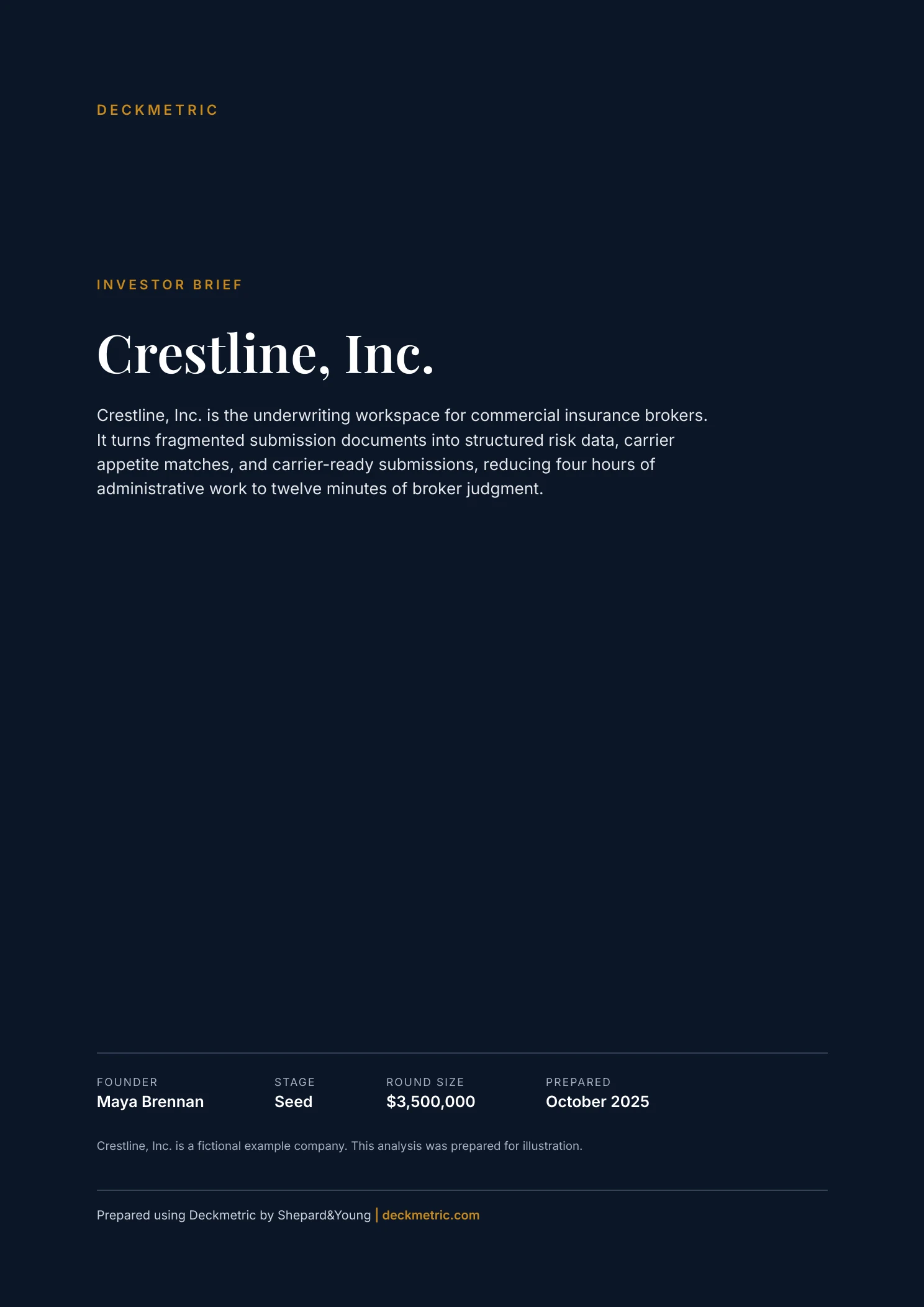
A better handoff
Turn founder-approved analysis into a consistent brief with company context, selected evidence and the round plan. Choose what to include; CVM scores are optional.
Explore the Investor Brief